2.3 million rooms sit empty in spacious homes. The student room shortage is 21,500.
We counted the bedrooms that go unused in small households aged 55 and over, per municipality, using public CBS and Eurostat register data. The result: an estimated 1.84 to 2.57 million empty rooms. The Dutch student room shortage of 21,500 fits into that 86 to 119 times.
If just over 1 in 100 of those rooms became a lodger's room, the student shortage would be gone.
Summary in four sentences
The Netherlands has 3,276,642 small over-55 households: people living alone and couples without resident children, aged 55 or over (CBS register data, 1 January 2025).
Based on dwelling size per municipality and the European under-occupancy rate, we estimate (counting at most one empty room per household, even where there are more) the number of unused bedrooms at 1.84 to 2.57 million (mid: 2.3 million).
The student room shortage is 21,500 rooms (Kences, 2025). That shortage fits 86 to 119 times into the empty rooms, a multiple of the 357,637 completely vacant dwellings the country has.
We do not claim all these rooms are available; we count physical space. The ratio shows that even minimal use would already solve the shortage. The question is not whether the space exists, but why renting it out feels so hard.
Four key figures
The ratio between empty rooms and the room shortage holds under any reasonable assumption. That is the point.
By student city
Estimated empty rooms in small over-55 households, in three scenarios, plus how many times the national shortage of 21,500fits into that city's mid scenario. Sorted high to low.
| City | Low | Mid | × shortage |
|---|---|---|---|
| Rotterdam | 31,340 | 57,800 | 2.7× |
| Amsterdam | 26,100 | 53,947 | 2.5× |
| The Hague | 28,526 | 46,826 | 2.2× |
| Utrecht | 15,186 | 24,858 | 1.2× |
| Eindhoven | 18,899 | 24,825 | 1.2× |
| Groningen | 14,391 | 20,872 | 1.0× |
| Nijmegen | 15,253 | 20,055 | 0.9× |
| Seven cities combined | 149,695 | 249,183 | 12× |
Kences does not publish the room shortage per city (only the national figure of 21,500for the nineteen student cities combined), so we compare each city against that national shortage. “Over-55 households” are single-person households plus couples without children aged 55 and over (CBS, 1 Jan 2025).
Method
Register data, not a survey. This is a calculation on public register figures. There is no sample and therefore no margin of error; the uncertainty lies in the assumptions, which we address with an explicit range (low/mid/high) instead of a single point estimate.
Step 1: the households. Per municipality we count single-person households aged 55+ and couples without children aged 55+ (CBS table 71488ned, 1 January 2025). Nationally: 3,276,642 households. Cross-checked against two other CBS tables; the single-person figures match exactly.
Step 2: three scenarios, always at most one room per household. Low: only households in dwellings of 100 m² or larger (share per municipality, CBS 83704NED). Mid: the Eurostat figure that 70.2% of Dutch over-65s live in an under-occupied dwelling (2024), adjusted downward per city for local dwelling size. High: all households in dwellings of 75 m² or larger.
The conservative choice. We count at most one empty room per household, even though many have two or more to spare. Guest rooms, hobby rooms and studies are therefore excluded once one is counted. We also count only among over-55s, while younger and larger households have spare rooms too. Every assumption pushes the count down, not up.
Independent anchor. The Eurostat under-occupancy rate (70.2%) sits neatly between our low scenario (dwellings ≥ 100 m²: 56.2% nationally) and our high scenario (≥ 75 m²: 78.4%). Three independent approaches point the same way.
Reproducible. All CBS and Eurostat data was retrieved via the official open-data APIs; the retrieval scripts, the model and the raw CSVs are available on request via onderzoek@huismaatje.nl. We explicitly invite CBS and researchers to do it more precisely. Then this figure finally exists officially.
Sources
- CBS StatLine, Huishoudens; personen naar leeftijd en regio (71488ned): Aantal eenpersoonshuishoudens en paren zonder kinderen van 55 jaar en ouder, per gemeente, peildatum 1 januari 2025. Kruisgevalideerd tegen 71486ned (directe huishoudenstelling) en 86065NED (bewoonde woningen naar leeftijd hoofdbewoner). Link
- CBS StatLine, Voorraad woningen; oppervlakteklasse, regio (83704NED): Woningvoorraad naar oppervlakteklasse per gemeente, stand 1 januari 2026. Hieruit het aandeel woningen van 75 m² en groter, en van 100 m² en groter. Link
- Eurostat, Share of people living in under-occupied dwellings (ilc_lvho50a): Aandeel Nederlanders dat in een onderbezette woning woont (meer kamers dan de norm), 65-plussers: 70,2% in 2024. Gebruikt als onafhankelijk anker voor het middenscenario. Link
- Kences, Landelijke Monitor Studentenhuisvesting 2025: Studentenkamertekort 21.500 (19 grootste studentensteden, studiejaar 2024-2025); prognose 26.000-63.200 in 2032-2033; uitwonendheid gedaald van 52% naar 44% in acht jaar. Link
- CBS StatLine, Voorraad woningen; bewoning, regio (82900NED): Bewoonde en onbewoonde woningen per gemeente, stand 2025. Nederland telt 357.637 onbewoonde woningen (klassieke leegstand) op een voorraad van 8,3 miljoen. Link
Downloads for press, researchers and bloggers
Free to use under Creative Commons BY 4.0. A single line of attribution is enough (see below).
CSV: scenario results per region
The model output (low/mid/high) for the Netherlands and seven student cities, one row per region.
model_resultaten.csvCSV: small over-55 households per region
The N the model rests on: single-person and child-free couple households aged 55+ per region (CBS 71488ned).
kernindicatoren.csvCSV: raw CBS and Eurostat data
Housing stock by size class, average dwelling area, vacancy, and the Eurostat under-occupancy anchor.
size class + 3 files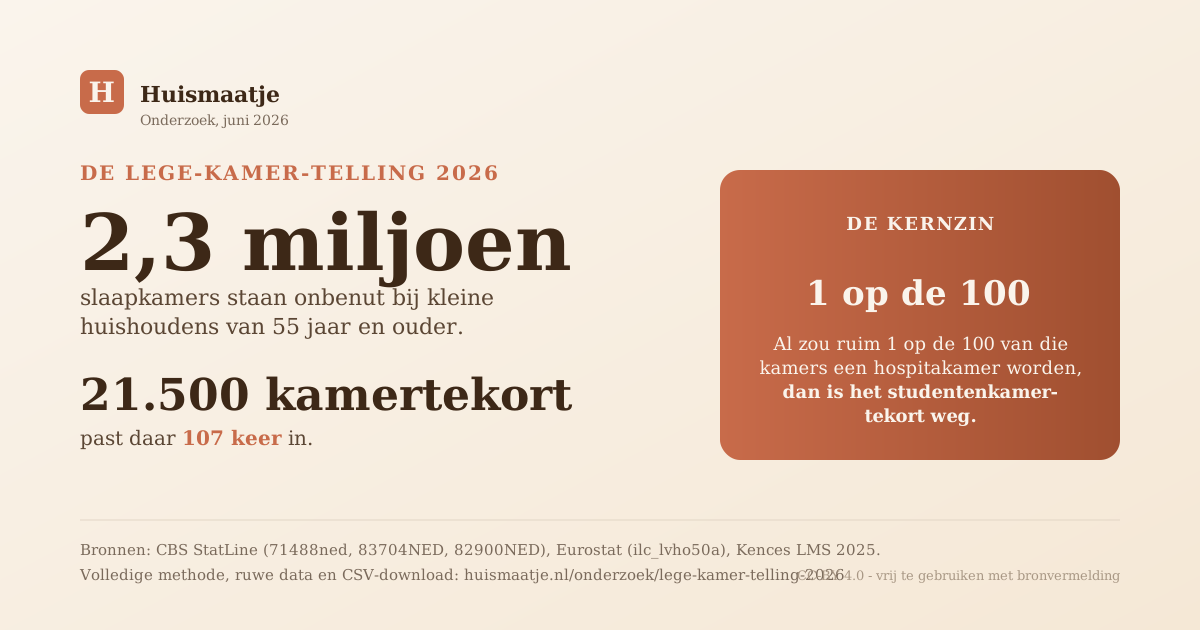
Embeddable key-figure graphic (SVG)
1200 x 630 pixels, scales without loss of quality, in the Huismaatje style. Free to use with attribution.
kerncijfer.svgPress kit with release and boilerplate
One page with the facts, contact details, company boilerplate and links to all the assets above.
Open the press kitWhat this figure does and does not say
Are those rooms even available?
No, and we never claim they are. We count physical space. The point is precisely that space is not the problem: less than 1% take-up already solves the shortage. The real question is why renting out feels so unappealing, and that is what we help with.
Don’t older people keep that room free on purpose?
Partly, yes: for guests, children or informal care. That is why we count at most one room per household, so the guest room stays out of the count once one is counted. How often a room actually sits empty is something we measure separately with fieldwork.
Isn’t this just advertising for your platform?
Huismaatje earns nothing from lodger renting; the platform is free and agent-free. We publish the method and data in full because no one else counts these rooms. CBS counts dwellings, Kences counts the shortage. The space in between went uncounted until now.
What this means
Four audiences, four conclusions.
For those living spaciously
You can rent out one room to a student while continuing to live there yourself. This is called lodger renting (hospitaverhuur). For owners, rent up to € 6,633 per year (2026) is tax-free, and there is a nine-month trial period during which you can stop without giving a reason. Our free guide walks you through it step by step.
For students and cities
In the seven largest student cities combined, the lowest scenario already amounts to 149,695 empty rooms, a multiple of the national shortage, inside the very cities where that shortage bites. The space is not in the wrong place.
For policymakers
The barriers to using this space are policy-made: mortgage conditions, the cost-sharing benefit rule and tenant protection weigh heavier than any lack of space. Since November 2025 Amsterdam has shown it can be done more precisely by partly exempting lodger income for people on benefits.
For press and researchers
All figures are free to use under Creative Commons BY 4.0, provided you credit Huismaatje. The full method, the retrieval scripts and the raw CSV data are available on request via onderzoek@huismaatje.nl.
How to cite
Free to use under Creative Commons BY 4.0. A single line of attribution is enough.
Is one of those rooms yours?
In five minutes you'll know whether you can become a lodger landlord, what you may charge and how to start. Free, no account needed, you can stop any time. We walk you through it.